
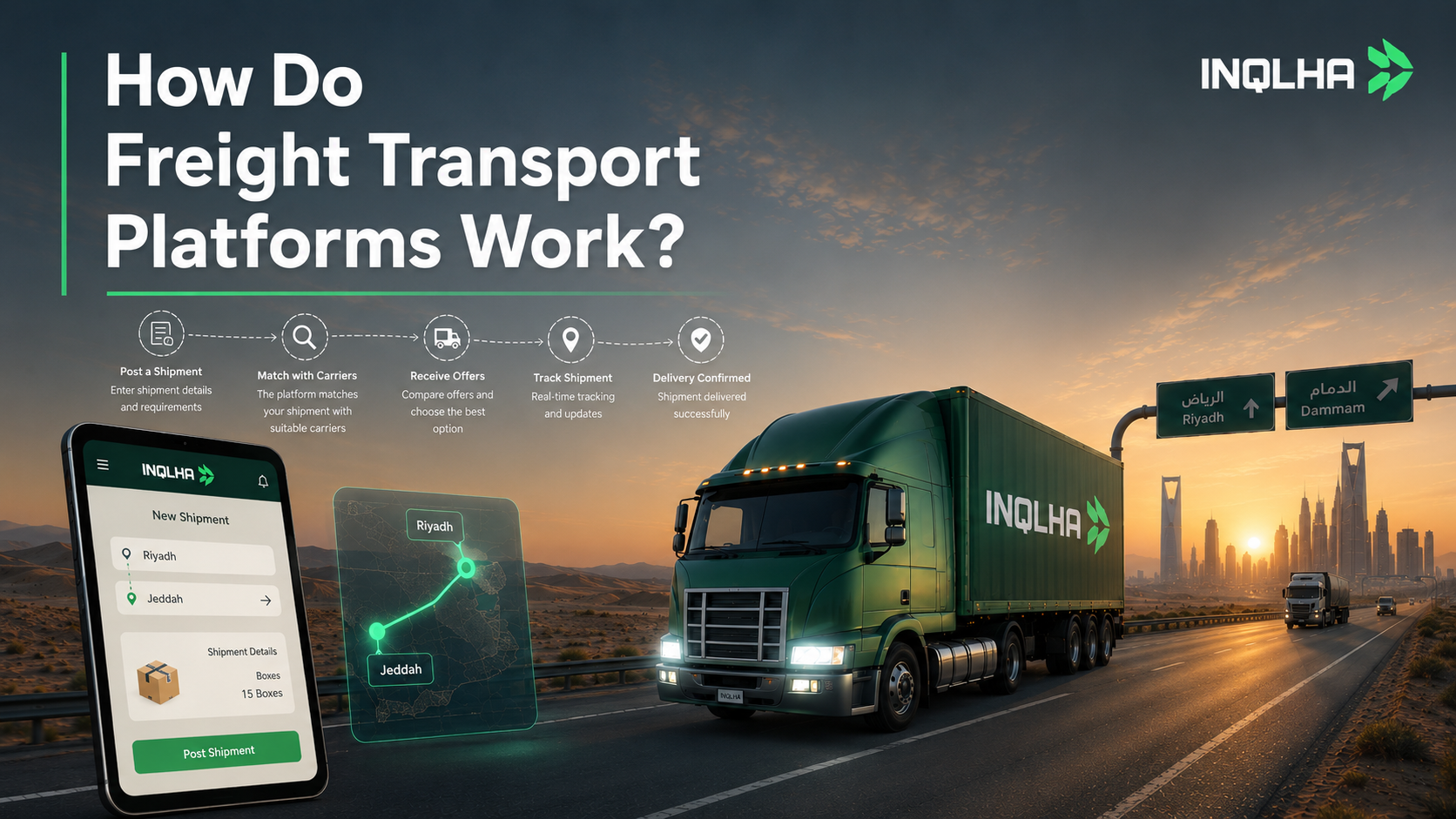

What Is a Digital Transport Platform? And How Does It Work in Saudi Arabia?
The freight transport sector in Saudi Arabia has witnessed a significant transformation in recent years with the emergence of digital transport platforms, which have changed how transport operations are managed and how shippers are connected with carriers, making the process faster, more organized, and transparent.
Instead of relying on phone calls or manually searching for a suitable carrier, companies and individuals can now create transport requests, receive quotes, and track the entire journey through a single digital platform.
In this guide, you will learn about the concept of a digital transport platform, how it works, the difference between it and traditional transport companies, and how it helps businesses and individuals manage transport operations efficiently within Saudi Arabia.
What Is a Digital Transport Platform?
Quick Summary
- A digital transport platform connects shippers with carriers through a unified electronic system.
- It helps manage the transport journey from creating the request to delivery.
- It provides request status tracking and operations management from one place.
- It suits companies that execute frequent transport operations and can also be used by individuals for many transport services.
A digital transport platform is an electronic platform that enables managing goods transport operations entirely online, from creating the transport request, through selecting the appropriate carrier, to tracking the journey execution and documenting the delivery process.
This model relies on technology to simplify procedures that were previously done through phone calls or direct communication with multiple transport companies, making shipment management more organized and easier.
The platform is not limited to just connecting customers with carriers; it also helps manage orders, organize shipment data, track trip statuses, and provide a complete record of all transport operations.
Why Did Digital Transport Platforms Emerge?
With the increase in trade volume, the expansion of intercity shipping operations, and the growing need for companies to execute a large number of daily transports, traditional methods became less efficient in managing these operations.
Previously, creating a transport trip required contacting multiple carriers, manually comparing prices, and then tracking execution through phone calls, which consumed significant time and effort, especially for companies managing tens or hundreds of shipments.
Therefore, digital transport platforms emerged to combine all process stages within one system, allowing order creation, receiving quotes, tracking execution, and managing past and present trips, making the transport process more organized and transparent for all parties.
How Does a Digital Transport Platform Work?
Digital transport platforms rely on transforming the traditional transport journey into an integrated digital process, where all steps are completed through an app or electronic platform without needing to manage each stage separately.
Although some details may differ from one platform to another, the workflow generally goes through the following stages:
Stages of the Transport Request Journey
- Create the transport request specifying shipment details, pickup location, delivery destination, and any special requirements for the trip.
- Review the request and ensure data completeness, preparing the request to be presented to carriers or processed according to the platform’s mechanism.
- Receive transport quotes so the customer can compare submitted offers and choose the most suitable one based on price, rating, or other factors.
- Start the trip execution with the ability to track the request status and shipment location during transit.
- Complete the delivery and document the operation within the platform, with the option to rate the experience and refer back to trip data later.
(As shown in the screenshot: example of creating and tracking a transport request via the Inqlha app)
Components of a Digital Transport Platform
A digital transport platform typically consists of a set of systems that work together to manage the transport journey in an integrated manner. The most important ones are:
- System for creating and managing transport requests.
- Dashboard for tracking current and past trips.
- System for receiving transport quotes and selecting the best fit.
- Tools for tracking shipment status during execution.
- Communication channels between customer and carrier.
- System for managing invoices and operations history.
- Tools for technical support and account management.
Features vary from one platform to another, but the core goal remains the same: simplifying transport operations management and making it faster, more transparent, and efficient.
How Do Companies Benefit from a Digital Transport Platform?
Today, companies rely on transportation for many daily operations, whether moving raw materials, distributing products, or sending shipments between branches and customers. As the number of trips increases, managing transport operations manually becomes more complex, and more time is spent coordinating with carriers and tracking each request individually.
That’s why digital transport platforms emerged, gathering all transport operations within one system, helping companies create requests, track execution, and manage trips from one place instead of relying on phone calls or traditional spreadsheets.
Instead of treating each trip as a separate operation, the company can manage all transport operations within a unified operations dashboard and refer back to any trip’s data at any time.
To implement this within Inqlha, company managers can track all current, past, and scheduled requests through the orders dashboard, with the ability to create new requests and manage trips from a single screen.
(As shown in the screenshot: the orders dashboard within Inqlha)
How Does a Digital Transport Platform Help in Managing Transport Operations?
Transport management doesn’t stop at creating the request; it includes tracking its execution, communicating with the carrier, knowing the shipment status, and referring back to trip details when needed.
As the number of orders increases, it becomes difficult to track each trip separately. Therefore, modern platforms rely on an operations dashboard that displays all requests and their status in real-time, giving operations teams a clearer view of workflow.
These systems also help organize current and future trips and reduce the time the operations team spends manually following up on each process.
To apply this practically within Inqlha, the orders screen displays all trips with their current status—whether awaiting quotes, in progress, or completed—making it easy to track daily operations without searching through messages or calls.
(As shown in the screenshot: orders screen)
How Does a Digital Transport Platform Help Reduce Costs?
Transport cost is not determined by the trip price alone; it’s also influenced by how requests are managed, the speed of finding the right carrier, and the efficiency of trip execution.
When a company relies on traditional methods to find carriers, it may spend more time getting a suitable offer, or be forced to accept the first available offer without comparing different options.
In digital transport platforms, you can receive multiple quotes for the same request, giving the company the opportunity to choose the most suitable offer in terms of price, execution speed, or carrier rating.
The platform also helps reduce the administrative time required to create and track requests, which reflects in lower operational costs over time.
Within Inqlha, companies can receive multiple quotes for the same transport request, then review them and select the best offer directly from the app.
(As shown in the screenshot: price quotes screen)
Tracking, Order Management, and Invoices
Every transport operation goes through several stages, from creating the request to delivering the shipment. Therefore, companies need to know the status of each trip at any time without relying on constant communication with the carrier.
That’s why digital transport platforms provide tools to track requests in real-time, while keeping a complete record of all past trips, making it easy to refer back to them when needed.
These systems also help organize invoices for each trip and store them within the company account, simplifying accounting and financial review tasks.
To execute this within Inqlha, you can track the request status in detail, review all past trips, and download the invoice for each trip separately.
(As shown in the screenshot: order details or invoices screen)
Packages and Contracts for Companies
Company needs differ from individual customers; companies often execute transport operations continuously and may need to manage dozens or hundreds of trips per month.
Therefore, some digital transport platforms offer dedicated solutions for business clients, such as operational packages, long-term contracts, and personalized support, proportionate to the volume of transport operations.
These solutions also help companies plan transport costs better and benefit from competitive pricing as order volumes increase.
In Inqlha, companies can contact the sales team to get solutions and packages that fit their transport volume, instead of relying solely on individual requests.
When Does Your Company Need a Digital Transport Platform?
Not all companies may need a specialized platform from the start, but as business grows and the number of transport operations increases, the need for a unified system becomes more critical.
It’s often the right time to rely on a digital transport platform when:
- The number of transport operations increases regularly.
- It becomes difficult to track all requests manually.
- The company needs to compare more than one offer per trip.
- You want real-time shipment tracking.
- You need to keep a complete record of orders and invoices.
- You are looking for a more organized way to manage daily transport operations.
At this stage, the platform is no longer just a way to order a truck, but a tool that helps organize the entire transport operations.
Digital Transport Platform vs. Traditional Transport Company
It may seem that a digital transport platform and a traditional transport company offer the same service, but the real difference lies in the way the transport process is managed.
A traditional transport company often relies on its own fleet to execute trips, while a digital transport platform relies on managing requests and connecting customers with carriers through an electronic system, providing tools that help track and organize trips.
| Comparison Criteria | Digital Transport Platform | Traditional Transport Company |
|---|---|---|
| Request Creation | Electronically via the platform | Often via phone or direct contact |
| Quote Comparison | Available on some platforms | Usually not available |
| Trip Tracking | Real-time via a dashboard | Varies by company |
| Invoice Management | Electronically from one place | Depends on company system |
| Trip History | Saved within the platform | Varies by work process |
This doesn’t mean one model is always better than the other; the choice depends on the nature of the business and company needs. Some modern companies, like Inqlha, combine offering a digital platform for request management with operational expertise in executing transport services, providing a more integrated customer experience.
How Does a Digital Transport Platform Work for Individuals (B2C)?
For individuals, a digital transport platform aims to simplify the process of moving goods, furniture, cars, or any large shipment without needing to contact multiple companies or manually search for a suitable transport method.
All order steps are completed through a single digital experience, from creating the request to receiving the shipment.
On most modern platforms, the customer can:
- Create a transport request within minutes.
- Specify the type of goods.
- Choose the transport date.
- Track order status.
- Communicate with the driver.
- Receive notifications for each stage.
- Rate the service after the trip ends.
Instead of relying on phone calls or manual coordination, all order data is saved and can be referred back to at any time.
The Individual Customer Journey
The transport process typically goes through several simple steps:
- Create the transport request.
- Specify pickup and delivery points.
- Select the shipment type.
- Add any details or photos that help clarify the load nature.
- Receive transport quotes and choose the appropriate offer.
- Track the request execution in real-time.
- Confirm receipt using the verification code (OTP).
- Rate the driver after the trip ends.
In some cases, a different person can also be assigned to receive or deliver the shipment, which facilitates transports where the requester is not present in person.
Transport Services That Can Be Requested via the Platform
Digital transport platforms are not limited to one type of shipment; they can be used to manage many different transport operations, such as:
- Commercial goods transport.
- Equipment transport.
- Industrial materials transport.
- Car transport.
- Furniture moving.
- Large appliance transport.
- Intercity transport.
- Inner-city transport.
Available services vary depending on the nature of each platform, and some offer dedicated solutions for both individuals and companies within the same app.
Available Truck Types
Digital platforms usually offer more than one transport vehicle option, so the customer can choose the appropriate vehicle for the nature of the load.
Options may include:
- Small trucks (Dina).
- Light-duty trucks.
- Medium-duty trucks.
- Heavy-duty trucks.
- Car carrier trailers.
- Specialized equipment trucks.
- Enclosed trucks.
- Open-bed trucks.
If the customer doesn’t know the right vehicle type, they can add shipment details or photos so the most suitable vehicle is chosen based on the load nature.
Safety and Trust Factors
The more valuable the shipment, the more important safety factors become when choosing a transport platform.
Therefore, it’s best to ensure the platform provides elements like:
- Verification of driver data.
- License and identity review.
- Previous customer ratings.
- Live trip tracking.
- Complete history of all orders.
- Delivery confirmation using a verification code (OTP).
- Ability to communicate with the driver during the trip.
- Technical support in case of any issues.
These elements do not prevent all problems, but they help make the transport experience more transparent and organized.
How to Choose the Right Transport Platform?
Before relying on any platform, it’s better to evaluate it according to a set of practical criteria, not just price.
The most important criteria include:
- Suitable geographic coverage.
- Variety of truck types.
- Ease of creating the request.
- Ability to track the shipment.
- Availability of driver ratings.
- Fast technical support.
- Pricing transparency.
- Documented history of all orders.
- Solutions suitable for both individuals and companies.
If your company executes transport operations continuously, it’s also useful to ensure there are tools for managing orders, invoices, and contracts within the platform.
The Future of Digital Transport Platforms in Saudi Arabia
The transport sector in the Kingdom is witnessing rapid digital transformation, and digital platforms have become an essential part of developing logistics services and improving transport efficiency.
With the growth of e-commerce, increasing shipment volumes, and rising reliance on digital solutions, these platforms are expected to play a greater role in the coming years in:
- Accelerating order execution.
- Improving truck utilization.
- Reducing empty trips.
- Enhancing customer experience.
- Increasing transparency.
- Supporting companies in managing daily transport operations.
These platforms will also increasingly benefit from technologies like artificial intelligence, data analytics, and vehicle tracking, helping to improve planning and make faster decisions.
Frequently Asked Questions
Is a digital transport platform a transport company?
Not always. Some platforms act as an intermediary between customers and carriers, while others combine technology with executing actual transport services.
Can individuals use a transport platform?
Yes, it can be used to move furniture, cars, goods, or any large shipments within the Kingdom.
Does the platform suit companies?
Yes, in fact, companies usually benefit the most from digital platforms when managing a large number of transport operations continuously.
Can I track the shipment during transport?
On most modern platforms, you can track the request status and know the execution stages until delivery is completed.
How do I choose the right truck?
You can choose the truck type directly if you know your needs, or add details and photos of the shipment so the most suitable vehicle is determined.
Whether you manage daily transport operations for your company or need to execute a single transport, the Inqlha platform helps you create requests, track shipments, and manage transport operations from one place.
You can create a new request, download the app, or contact the Inqlha team to find out the suitable solutions for your needs, whether you are an individual or a company.