
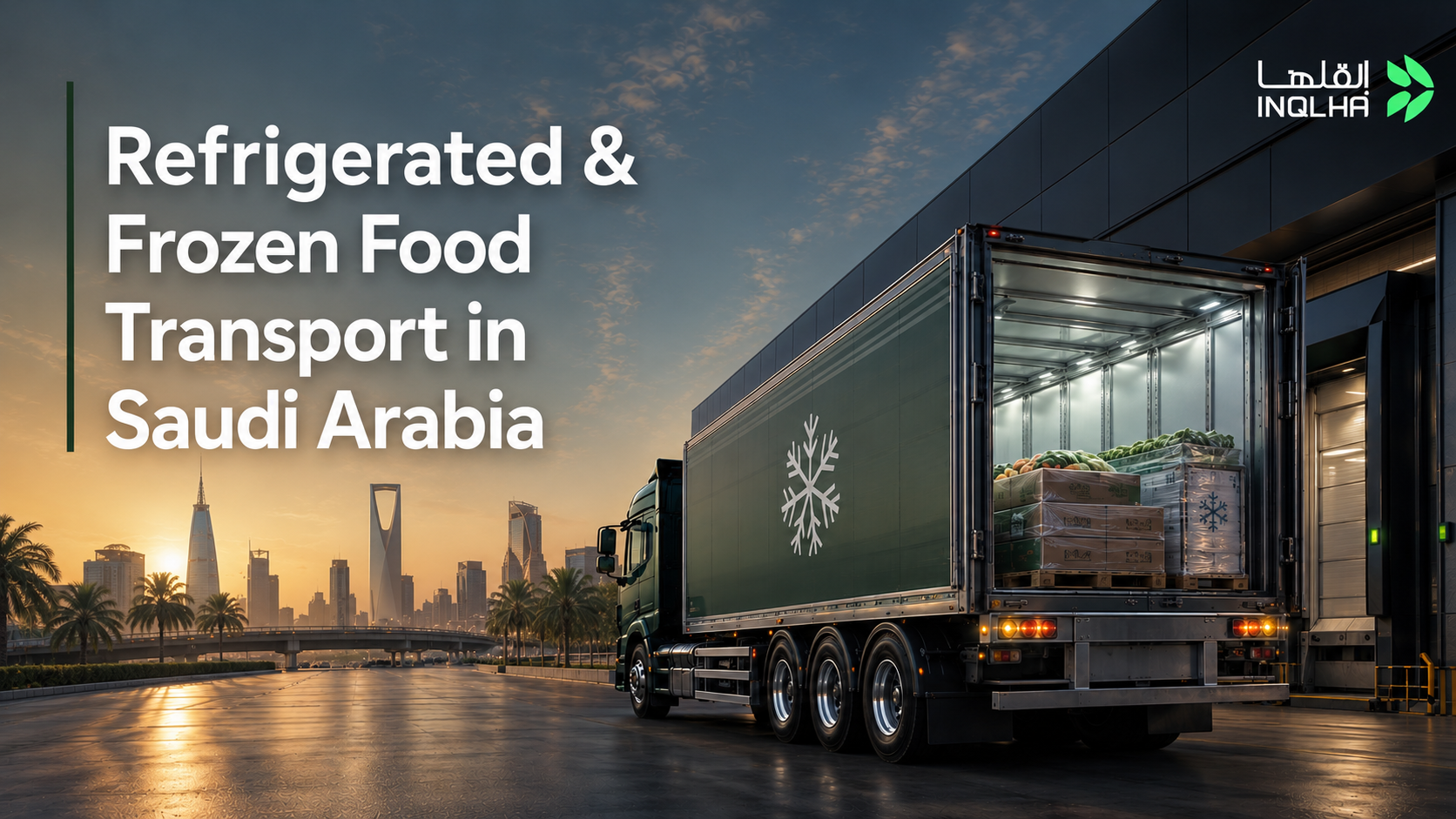

Refrigerated and frozen food transport in Saudi Arabia requires more than simply placing food inside a cooled truck. Product type, required temperature, journey duration, vehicle condition, loading method, airflow, delivery stops, and temperature monitoring can all affect how the shipment should be transported.
Through Inqlha, food manufacturers, suppliers, distributors, restaurants, retailers, and other businesses can define their refrigerated transport requirements, connect with suitable carriers, and compare transport offers based on the cargo, route, and operating conditions required for the journey.
Quick Summary
- Refrigerated food transport covers chilled, frozen, fresh, and other temperature-sensitive food products.
- Different foods require different transport conditions, so there is no single temperature suitable for every shipment.
- The refrigerated vehicle should have enough capacity and refrigeration performance for the actual cargo and route.
- Cargo should be loaded in a way that allows refrigerated air to circulate effectively around the load.
- Saudi Food and Drug Authority guidance includes temperature-monitoring requirements for chilled and frozen foods.
- Loading, unloading, and unnecessary door-opening time should be minimized to reduce exposure to warmer ambient conditions.
- Businesses can use Inqlha to define the shipment and compare carrier offers for the required route.
Start with the product requirements
Before requesting a truck, identify the food type, shipment condition, required transport temperature, cargo volume, pickup and delivery locations, and any temperature-monitoring or documentation requirements.
Refrigerated and Frozen Food Transport Solutions in Saudi Arabia
Refrigerated food transport supports the movement of temperature-sensitive products between farms, factories, suppliers, warehouses, distribution centers, restaurants, retail stores, and final delivery locations.
The correct solution depends on the shipment itself. A small chilled dairy delivery does not require the same transport setup as a large frozen food load traveling between cities. Vehicle capacity, refrigeration performance, trip duration, delivery schedule, and product requirements should therefore be evaluated together.
Chilled Food Transport
For food products that require suitable refrigerated conditions throughout the transport journey.
Frozen Food Transport
For products that must remain frozen using a vehicle and refrigeration system suitable for the required conditions.
Urban Distribution
For deliveries between warehouses, restaurants, retailers, branches, and other locations within a city.
Intercity Food Transport
For commercial food shipments moving between cities and regions across Saudi Arabia.
Refrigerated transport is one part of the cold chain
Product protection begins before the truck leaves. Pre-shipment storage, loading, transportation, unloading, and receiving conditions all contribute to maintaining the required cold chain.
For a broader explanation, see our cold chain transportation guide in Saudi Arabia.
What Types of Food Products Require Refrigerated Transport?
Many food products require temperature-controlled transportation because heat exposure or unsuitable storage conditions can affect quality, shelf life, or food safety. The exact requirements depend on the type of food, its processing method, packaging, condition at loading, and manufacturer or regulatory requirements.
Meat and Poultry
Chilled or frozen meat and poultry products require transport conditions suitable for their specific handling requirements.
Fish and Seafood
Temperature-sensitive products where journey time and cold-chain management can be particularly important.
Dairy Products
Milk, dairy products, and other chilled goods that require suitable refrigerated distribution.
Chilled Beverages
Beverages and liquid food products that require controlled transport conditions according to product specifications.
Fresh Produce
Fruits, vegetables, and other fresh goods whose quality can be affected by temperature, humidity, and journey duration.
Prepared and Processed Foods
Certain ready meals and processed food products require chilled or frozen transport according to their specifications.
Do not assign one temperature to every food shipment
Products within the same general food category can still have different transport requirements. Follow the applicable product specifications and handling instructions instead of applying one temperature range to every load.
Transporting Frozen Meat, Poultry and Seafood
Frozen meat, poultry, fish, and seafood require careful management of both time and temperature. The transport process should maintain the product in its required frozen condition and limit unnecessary exposure to warmer environments during handling.
Codex guidance for quick-frozen foods recommends minimizing handling at warmer air temperatures, completing loading and unloading as quickly as practical, preparing multi-destination loads in advance, and arranging cargo to allow refrigerated air to circulate around the load.
Product Condition at Loading
Frozen products should already be prepared and stored according to their required conditions before loading.
Temperature Stability
The transport process should maintain suitable conditions throughout the journey rather than relying on a single temperature check.
Door Opening Time
Opening the cargo area allows warmer ambient air to enter and should be managed carefully.
Refrigerated Airflow
Cargo placement should allow refrigerated air to circulate around and through the load where required.
Transport refrigeration is primarily designed to maintain product temperature
Food should be prepared at the correct condition before loading. Refrigerated transport equipment should not be treated as a substitute for properly chilling or freezing the product before the journey.
Transporting Dairy Products, Beverages and Chilled Goods
Dairy products, chilled beverages, and other refrigerated goods require suitable temperature conditions throughout distribution, particularly when a delivery route includes several stores, restaurants, or branches.
Repeated deliveries can introduce additional operational considerations because doors may be opened multiple times. Route planning, loading order, unloading speed, and refrigeration performance therefore become increasingly important in multi-stop distribution.
- Prepare products according to the required transport conditions before loading.
- Use a clean and suitable refrigerated food-transport vehicle.
- Arrange cargo so refrigerated airflow is not unnecessarily restricted.
- Minimize the time doors remain open during each delivery.
- Load products according to the planned delivery sequence.
- Use temperature monitoring or logging where required for the shipment.
Transporting Fresh Produce, Fruits and Vegetables
Fresh produce has different transport needs from frozen food, and not all fruits and vegetables require the same conditions. Temperature, humidity, ventilation, product maturity, and transport duration can all affect quality at delivery.
For this reason, choosing refrigerated transport for fresh produce should not simply mean selecting the lowest possible temperature. Certain products can be sensitive to excessive cooling, while others benefit from faster temperature management after harvesting and during distribution.
Fresh produce is not one temperature category
Identify the exact product before transport and follow the appropriate storage and transportation requirements for that commodity rather than using the same setpoint for every fruit or vegetable.
Refrigerated Transport for Restaurants, Retailers and Food Businesses
Restaurants, retailers, food manufacturers, distributors, and suppliers use refrigerated transportation for different parts of their supply chain, from inbound ingredients to branch distribution and recurring commercial deliveries.
Restaurants and Kitchens
Transporting meat, dairy, vegetables, frozen ingredients, and other food products from suppliers to operating locations.
Retailers and Supermarkets
Moving chilled and frozen products to branches, stores, and points of sale.
Food Manufacturers
Transporting products between manufacturing facilities, warehouses, distributors, and distribution centers.
Suppliers and Distributors
Managing refrigerated distribution to one or several customers and delivery locations.
For businesses planning recurring routes, vehicle type, distance, shipment size, timing, and delivery stops can all influence refrigerated transport cost in Saudi Arabia.
Need to transport chilled or frozen food?
Define the food type, shipment volume, route, and temperature requirements to start exploring suitable refrigerated carrier options.
Maintaining the Right Temperature Throughout Food Transport
Maintaining suitable conditions during food transport depends on the complete operating process, not simply the temperature set on the refrigeration controller.
Before Loading
Confirm that the food is ready for transport according to its requirements and that the vehicle is clean, suitable, and prepared for the journey.
During Loading
Load efficiently and avoid leaving temperature-sensitive products in uncontrolled conditions longer than necessary.
Inside the Vehicle
Arrange cargo so the load does not block important airflow paths or the refrigeration evaporator.
During Transport
Temperature should be monitored or recorded according to the type of food, applicable requirements, and vehicle equipment.
At Delivery
Reduce unnecessary unloading time and move products into the appropriate receiving or storage environment as efficiently as possible.
Chilled and frozen food shipments require suitable temperature monitoring
Saudi Food and Drug Authority guidance identifies chilled and frozen foods, as well as shipments requiring a specific transport or storage temperature according to manufacturer instructions, as products requiring an activated temperature data logger or digital temperature indicator from the time of shipping.
Shipment Tracking and Delivery Documentation for Refrigerated Food
Food businesses often need visibility beyond knowing that a truck has departed. Tracking the transport journey and documenting delivery can provide a clearer operational record between suppliers, manufacturers, warehouses, branches, and customers.
Shipment Tracking
Follow the status of the transport journey through to the defined delivery location.
Delivery Documentation
Documenting shipment receipt provides a clearer record that the transport process has been completed.
Digital Records
Organize transport-related documents and invoices associated with the shipment through the platform.
Temperature Requirements
If specific temperature recording or monitoring is required, include it in the request and confirm the carrier’s capability.
Vehicle tracking and temperature logging are different functions
Following a vehicle’s location or shipment status does not automatically provide a continuous record of cargo temperature. When a temperature data logger is required, confirm that appropriate equipment is available and activated for the shipment.
Refrigerated Food Transport Between Cities in Saudi Arabia
Intercity refrigerated transport supports food supply chains moving goods from factories, farms, suppliers, and warehouses to distribution centers, retailers, restaurants, branches, and customers across Saudi Arabia.
As journey distance increases, planning becomes more important because transport duration, vehicle capability, temperature management, delivery stops, loading times, and receiving schedules all affect the overall transport process.
- Define exact pickup and delivery locations.
- Estimate the expected journey and route duration.
- Select a vehicle suitable for the cargo type and volume.
- Define temperature requirements before loading.
- Plan multiple delivery points in advance where applicable.
- Reduce unnecessary stops and prolonged door openings.
- Specify temperature-monitoring or logging requirements.
- Organize receiving and delivery documentation before arrival.
For more detail on selecting the vehicle itself, explore our guide to refrigerated trucks and reefer vehicle types in Saudi Arabia.
How Refrigerated Food Transport Works Through Inqlha
Inqlha operates as a digital logistics marketplace rather than a traditional transport company with an owned fleet. Shippers define their transport requirement, and carriers can evaluate the request and provide suitable offers.
STEP 01
Provide the food type, chilled or frozen condition, cargo volume, and any special requirements.
STEP 02
Enter the pickup point, destination, delivery stops, and required transport date.
STEP 03
Include the required temperature, preferred vehicle category, and monitoring or documentation requirements where applicable.
STEP 04
Review vehicle suitability, price, route, schedule, and included requirements before selecting an offer.
STEP 05
Follow the transport process through delivery and document shipment receipt.
Turn your food-shipment requirements into a clear transport request
Define the cargo, route, temperature requirements, and delivery schedule, then compare suitable carrier options through Inqlha.
Request Refrigerated or Frozen Food Transport
The quality of the offers you receive depends heavily on the information included in the transport request. Providing clear shipment details helps carriers evaluate the required vehicle, refrigeration capability, route, and operating conditions.
- Food type: Meat, dairy, produce, frozen goods, prepared food, or another product.
- Product condition: Chilled, frozen, or another specified temperature range.
- Shipment size: Weight, dimensions, pallet count, carton count, or overall volume where available.
- Pickup location: City and exact collection point.
- Delivery destination: City and final receiving location.
- Distribution stops: Include all destinations for multi-stop routes.
- Transport date: Required pickup date and time where applicable.
- Temperature requirement: Based on the product specification or applicable requirement.
- Monitoring: Specify requirements for temperature indicators, data loggers, or other monitoring.
- Special handling: Include loading, unloading, documentation, or other food-specific requirements.
For additional regulatory and operational considerations, review refrigerated transport requirements and compliance in Saudi Arabia.
Frequently Asked Questions About Refrigerated and Frozen Food Transport
What is refrigerated food transport?
Refrigerated food transport is the movement of food products in vehicles designed to maintain suitable temperature conditions throughout the journey according to the requirements of the cargo.
What is the difference between chilled and frozen food transport?
The main difference is the product condition and required transport temperature. Frozen goods need to remain under conditions suitable for maintaining their frozen state, while chilled foods have different requirements depending on the specific product.
What food products commonly require refrigerated trucks?
Examples include meat, poultry, seafood, dairy products, chilled beverages, fruits, vegetables, frozen foods, prepared meals, and other products that require specified transport temperatures.
Is there one temperature suitable for all refrigerated foods?
No. Temperature requirements vary according to the product, processing method, storage specification, and applicable handling instructions. Each shipment should be evaluated according to its actual requirements.
Do chilled and frozen foods need temperature data loggers in Saudi Arabia?
Saudi Food and Drug Authority guidance identifies chilled and frozen foods, as well as shipments requiring a specific transport or storage temperature according to manufacturer instructions, as products requiring an activated temperature data logger or digital temperature indicator from the time of shipping.
Does cargo loading affect refrigerated transport performance?
Yes. Cargo should be loaded to allow refrigerated air to circulate effectively. Blocking major airflow paths or the evaporator can reduce the ability of the refrigeration system to maintain consistent conditions throughout the load.
Why should refrigerated truck doors remain closed as much as possible?
Opening the cargo area allows warmer ambient air to enter. Limiting unnecessary door-opening time helps reduce disruption to the controlled environment, particularly on multi-stop distribution routes.
Can refrigerated food be transported between cities in Saudi Arabia?
Yes. Intercity refrigerated shipments can be arranged by defining pickup and delivery locations, cargo requirements, vehicle type, transport date, and temperature conditions before selecting a carrier.
How do I choose the right refrigerated truck for food transport?
Consider food type, shipment weight and volume, temperature requirements, route length, delivery stops, and loading conditions. Our refrigerated truck guide provides more detail on vehicle selection.
Does Inqlha own refrigerated food trucks?
No. Inqlha is a digital logistics marketplace and does not operate as a truck-owning transport company. The platform connects shippers with carriers so they can compare options suitable for each transport request.
References
General Requirements for Food Transport
— Saudi Food and Drug Authority (SFDA)
Temperature Indicator and Data Logger Requirements During Transportation
— Saudi Food and Drug Authority (SFDA)
Temperature and Humidity Tracking for Food and Drug Transport Vehicles
— Saudi Food and Drug Authority (SFDA)
Code of Practice for the Handling of Quick Frozen Foods During Transport
— Codex Alimentarius — FAO/WHO
START YOUR FOOD SHIPMENT
Need Refrigerated or Frozen Food Transport?
Share your food type, shipment volume, pickup and delivery locations, and temperature requirements to start exploring suitable carrier offers through Inqlha.
Explore More About Refrigerated Transport
- Refrigerated Transport and Reefer Trucking in Saudi Arabia
- Refrigerated Transport Cost in Saudi Arabia
- Reefer Lorries, Refrigerated Trucks and Vehicle Types
- Pharmaceutical Temperature-Controlled Transport in Saudi Arabia
- Cold Chain Transportation in Saudi Arabia
- Refrigerated Transport Requirements and Compliance in Saudi Arabia