
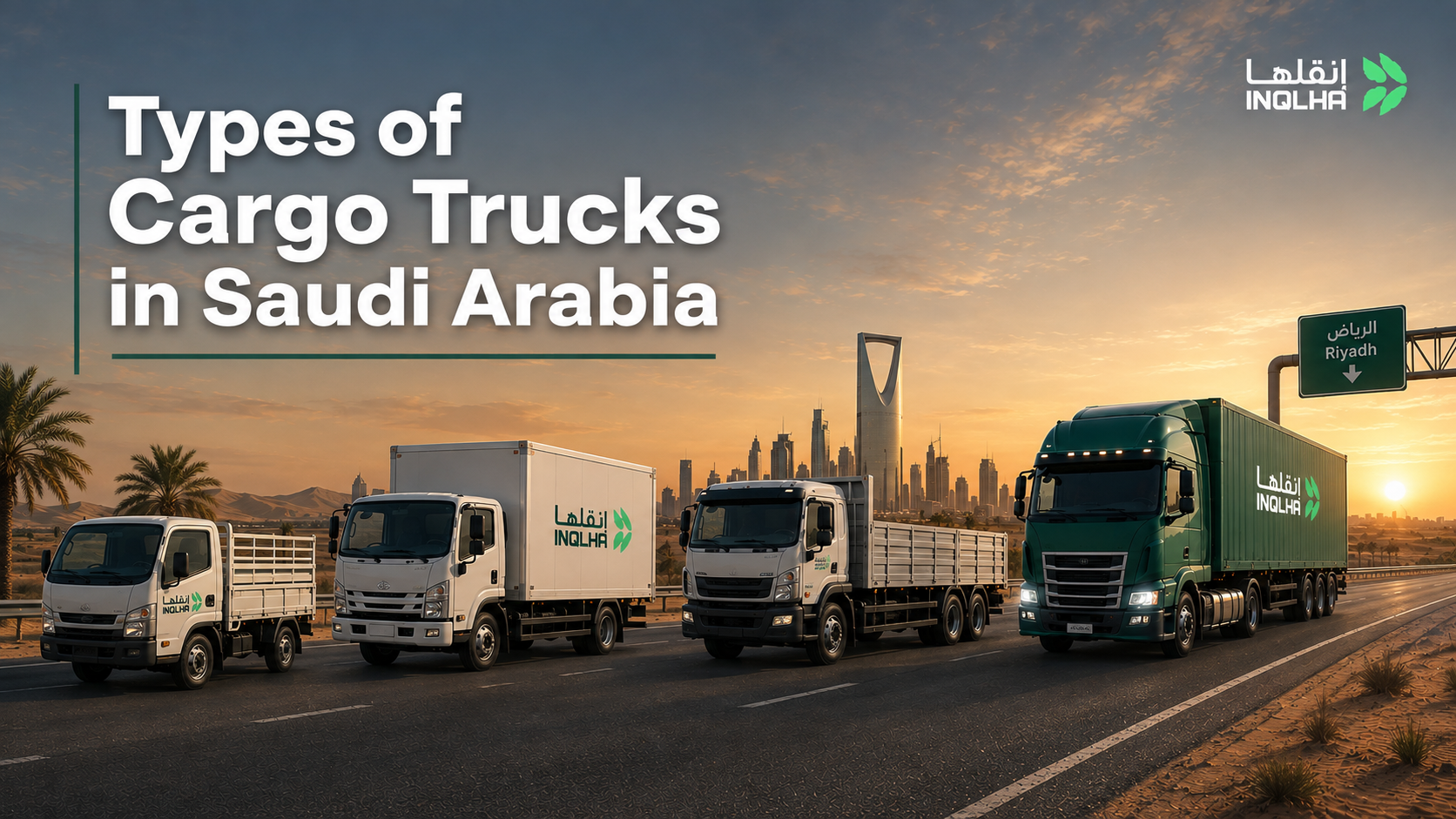
Types of Cargo Trucks in Saudi Arabia and How to Choose the Right One for Your Shipment

Choosing a freight transport vehicle is no longer just a simple operational step; it has become a fundamental part of the success of the transport operation itself. Selecting the right truck directly impacts trip cost, cargo safety, execution speed, and even the entire customer experience.
From the perspective of the Inqlha platform, truck types are not treated as a separate list that the customer needs to memorize, but as an intelligent system guided by the nature of the request, where each shipment is automatically matched with the right truck through offers and competition among drivers.
Why Choosing the Truck Type Is No Longer a Simple Decision
In the past, the customer had to understand the differences between truck types and choose the appropriate one themselves before requesting the service. But this model is no longer practical, especially with the diverse nature of today’s shipments.
Today, the same customer might need to transport:
- Light commercial goods
- Sensitive electronic devices
- Heavy construction materials
- Products requiring continuous refrigeration
Each of these cases requires a different type of truck, making the selection decision complex without logistics expertise. For this reason, “choosing the truck” is no longer a direct decision for the customer alone; it has become part of an intelligent process based on data, offers, and driver ratings within the Inqlha platform.
How Inqlha Redefines the Freight Transport Process
The Inqlha platform treats the transport process as an integrated operating system, not just a broker for booking a truck. Instead of the customer choosing the truck type in advance, they simply:
- Create a transport request with shipment details
- Receive offers from drivers using different types of trucks
- Compare offers based on price, rating, and execution speed
- Select the most suitable offer from an operational and commercial standpoint
In this way, the decision to choose a truck is transformed from a “technical” decision on the customer to a natural “operational” outcome within the marketplace itself. The platform also enables drivers to showcase their true capabilities through the type of truck available to them, creating a more efficient and transparent balance between supply and demand.
Types of Freight Transport Vehicles and Their Uses Within Inqlha
Within the Inqlha platform, each type of truck is automatically matched with its most suitable use based on the nature of the request, helping to reduce operational errors and improve transport efficiency.
🚛 Dump Trucks (Transporting Construction Materials and Projects)
Used for transporting bulk materials and construction projects such as sand, gravel, construction waste, and infrastructure materials. This type is often used in construction-oriented requests that require rapid unloading and large quantities.
📦 Enclosed Box / Jumbo Trucks (Commercial Goods and Distribution)
Suitable for transporting products that need protection during transit like commercial goods, electronics, inter-branch distribution shipments, and multi-piece goods. They are primarily relied upon in organized B2B commercial operations within the platform.
🚚 Flatbed Trailers (Heavy Equipment and Irregular Shipments)
Used for transporting large or irregularly shaped shipments such as heavy equipment, industrial machinery, and shipments with non-standard dimensions. This type offers high loading flexibility but requires special securing and tie-down.
❄️ Refrigerated Trucks (Food, Pharmaceuticals, and Sensitive Shipments)
Dedicated to shipments that require a constant temperature during transport, such as foodstuffs, medical products, and perishable materials. Within Inqlha, this type is automatically directed to requests containing temperature-sensitive requirements.
🚐 Pickup Trucks (Light Transport and Inner-City Requests)
Used for quick and light transport within cities, like individual requests, light furniture, and express shipments. They are the most used option for B2C requests due to their speed and easy access within neighborhoods.
When Do You Need Each Type of Truck? (The Smart Selection Logic Inside Inqlha)
Within the Inqlha platform, the truck type is not chosen randomly or based on the customer’s prior knowledge. Instead, the decision is transformed into a “smart operational logic” that relies on the details of the request itself, then automatically matched with suitable offers from drivers. This means that the truck selection depends on a set of signals that determine the best transport type for each shipment.
Based on the Type of Goods
The type of goods is the primary factor in determining the appropriate truck, as each category requires a different transport environment.
- Commercial goods and parcels → Usually need enclosed box trucks
- Food and pharmaceuticals → Need refrigerated trucks
- Construction and building materials → Need dump trucks
- Large or uncovered equipment → Need flatbed trucks
- Small inner-city requests → Suited to pickup trucks
The clearer the goods type is defined in the request, the more accurate the offers presented.
Based on Shipment Size and Weight
Size and weight determine not only the truck type but also the number of trips or the required vehicle capacity.
- Light shipments → Pickup or small box truck
- Medium shipments → Enclosed box or jumbo truck
- Heavy or very large shipments → Flatbed, dump, or high-capacity jumbo trucks
Within Inqlha, drivers submit offers based on their actual load capacity, reducing the problem of choosing an unsuitable truck.
Based on Product Sensitivity and Packaging
Some shipments depend not only on size but also on their sensitivity during transit.
- Fragile products → Need enclosed and secure trucks
- Products requiring cooling → Refrigerated trucks
- Heavy industrial equipment → Flatbed trucks with good securing
The more sensitive the shipment, the more important it is to choose a transport method that provides greater protection during the journey.
Based on Distance and Timing
The time and distance factor directly impacts the appropriate truck type and execution efficiency.
- Inner-city transport for short distances → Pickup or small trucks
- Intercity transport for long distances → Enclosed or jumbo trucks
- Urgent shipment → The fastest available offer is selected regardless of type within appropriate constraints
The Inqlha platform handles this factor by sorting offers based on speed and availability.
Based on the Number of Different Delivery Points
Some transport operations are not from a single point to a single point but involve multiple delivery locations.
- Single delivery → Any suitable truck type depending on the goods
- Multiple delivery points → Trucks with better loading flexibility and internal organization
- Commercial distribution → Enclosed or jumbo trucks are often chosen to reduce trips
The more delivery points, the more important operational planning becomes within the platform, not just vehicle selection.
With this logic, choosing a truck transforms from a complex manual decision into an intelligent outcome based on the request data itself, distinguishing the Inqlha experience in managing transport operations more efficiently and realistically.
How the Transport Experience Works Inside the Inqlha Platform
The transport experience within the Inqlha platform relies on transforming the process from a traditional “truck request” into an integrated operational journey managed entirely through a single digital system, connecting the customer, driver, and operations teams at every stage. Instead of fragmented communication or managing each step manually, the experience is unified within a clear path that starts with the request and ends with trip evaluation and analysis.
Creating a Transport Request
The journey begins when the customer creates a transport request within the platform, specifying shipment details such as: type of goods, pickup and delivery points, required transport time, and any special notes or requirements. This request becomes the starting point on which the rest of the process is built.
Receiving Offers from Drivers and Choosing the Most Suitable
After the request is posted, available drivers submit their offers based on: the type of truck they have, the proposed price, execution time, and driver rating and experience. The customer can compare offers and choose the most suitable based on a mix of price, quality, and reliability, not just price.
Service Customization (Loading – Assembly/Disassembly – Packaging)
The service is not limited to transport only; it can be customized as needed, such as: loading and unloading services, furniture assembly and disassembly, and packaging and protection during transit. This brings the transport experience closer to an “integrated logistics solution” rather than just a truck.
Scheduling Transport According to Your Plan
The Inqlha platform provides flexibility in specifying execution time, whether immediate transport or pre-scheduled for a later time. This allows companies and individuals to organize transport operations according to their operational or personal plans.
Real-Time Shipment Tracking
During the trip, the shipment status can be tracked directly within the platform, including: trip status, shipment location, and execution stages. This provides a higher level of transparency and reduces the need for constant communication.
Rating After Delivery (Rating System)
After the transport operation is completed, the trip is closed through receipt confirmation, entering an OTP code to ensure correct delivery, and rating the driver and service. This step helps improve service quality within the platform over time.
Complete Shipment Management, Not Just Vehicle Booking
Here, the platform transforms from a booking tool into a transport operations management system, where you can: track all requests from one place, view current, past, and future requests, and control each trip individually.
Dashboard for All Orders (Current – Past – Future)
The dashboard provides a comprehensive view of all operations, helping to organize shipments, reduce operational chaos, and improve decision-making.
Modify Price, Time, and Cancel Order
The platform grants full operational flexibility through the ability to modify order details, change the execution time, and cancel the order when needed.
Instant Notifications for Every Update
The user is notified of any changes to the order, such as: offer accepted, trip started, arrived for delivery, and operation completed.
Flexible Solutions for Companies (B2B Logistics Operations Layer)
For companies, the Inqlha platform transforms into an integrated logistics operations layer that helps manage supply chains more efficiently. These solutions include:
- Dynamic pricing based on volume and loads — Prices are determined based on order size and number of shipments.
- Bulk order discounts — Special pricing for frequent or large orders.
- Issuing invoices for each trip (Invoices) — Each transport operation has a separate downloadable invoice.
- Managing multiple shipments simultaneously — The ability to run more than one request concurrently.
- Full operational support for supply chains — Providing a comprehensive operational view of logistics operations for companies.
The Safety and Trust Experience Inside the Inqlha Platform
The platform focuses on building a layer of trust between the customer and the driver through:
- Driver Verification (KYC) — Ensuring the identity and credibility of drivers.
- Driver data and previous ratings — Displaying a clear record for each driver before selecting an offer.
- OTP code for delivery and receipt — Guaranteeing correct delivery and receipt of the shipment.
- Real-time status tracking — Continuous monitoring of the shipment’s movement during the trip.
The Driver’s Role Within the Platform (Marketplace Side)
Conversely, the driver works within the platform as an independent service point within an open marketplace system, with tools including:
- Receiving requests and setting price — The driver submits competitive offers according to the request.
- Managing current and past orders — A dedicated dashboard for the driver to organize their operations.
- Wallet and payments — Tracking earnings and payments within the system.
- Rating customers — The ability to also rate customers to improve market quality.
- Referral and bonus system — Incentivizing drivers to expand and increase activity within the platform.
Frequently Asked Questions About Freight Transport Vehicle Types
Do I need to know the truck type before creating a transport request?
No. Within the Inqlha platform, the customer is not required to know the truck type in advance, because drivers submit their offers based on the shipment details, and the most suitable option is chosen from the available offers.
How do I know I chose the right truck?
The appropriate truck is determined indirectly through the nature of the goods, the shipment size and weight, the type of offer submitted by the driver, and the rating and performance history. The platform helps you reach the right decision without needing logistics expertise.
Can I change the truck type after confirming the order?
In some cases, the order can be modified or the offer replaced before execution begins, depending on the order status and the availability of alternatives within the platform.
What is the difference between enclosed and open trucks?
Enclosed trucks: protect goods from external factors like rain and dust. Open or flatbed trucks: are used for large or non-sensitive loads that do not require enclosed protection.
Are all truck types available in every city?
Coverage varies by location and driver availability, but the Inqlha platform works to provide the widest possible variety of trucks to cover different requests within the service area.
Can I track the shipment during transport?
Yes, you can track the shipment status in real time within the platform until the delivery process is completed.