
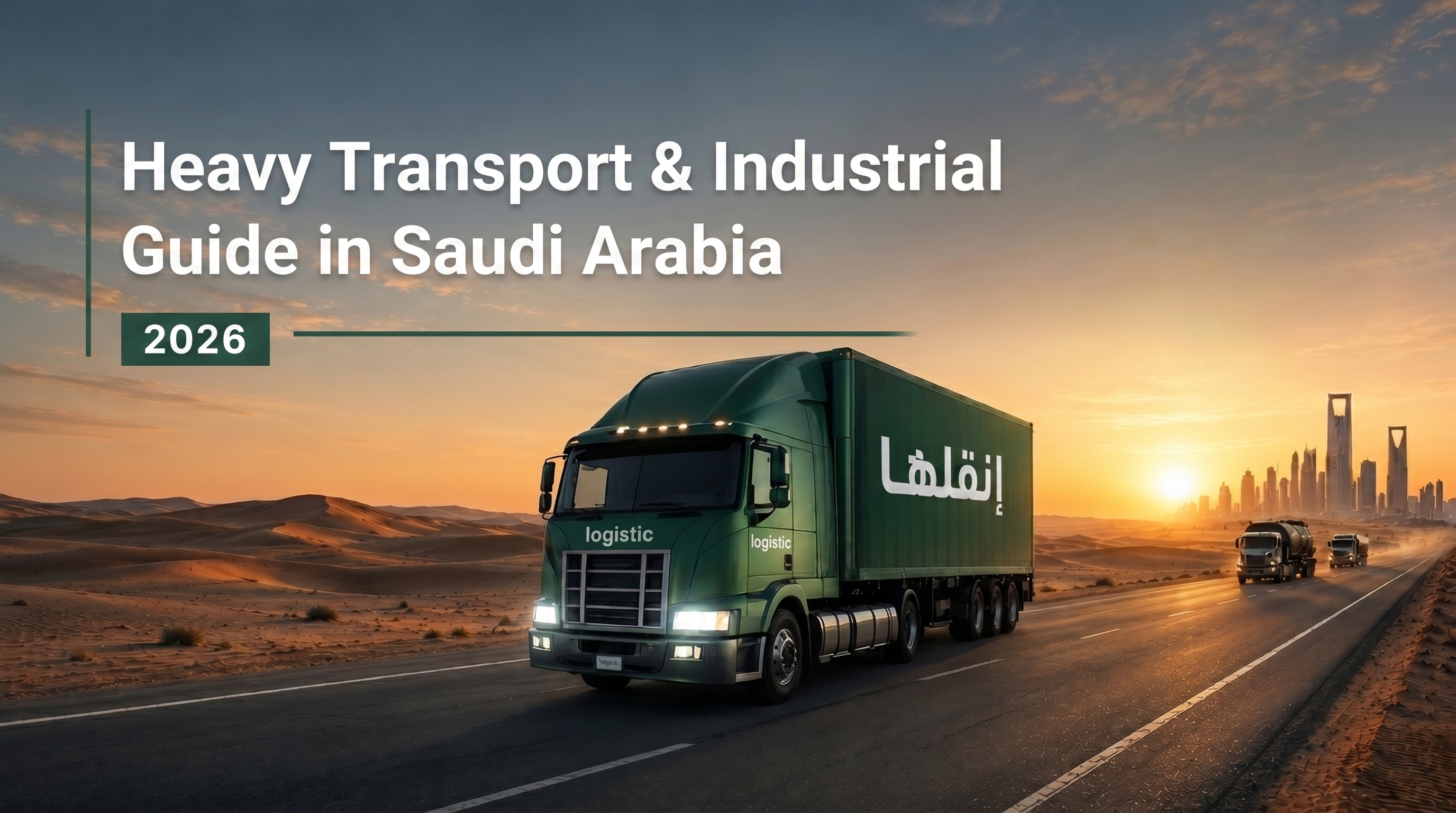
Heavy Transport and Industrial Logistics in Saudi Arabia: The 2026 Ultimate Guide

What Is Heavy Transportation and Why Is It Different from Regular Shipping?
Summary
This section explains the concept of heavy transportation in Saudi Arabia and how it differs from regular shipping, focusing on weights, dimensions, and the role of regulatory frameworks in managing operations.
Heavy transportation refers to the movement of goods using trucks with a gross vehicle weight exceeding 3,500 kg. It includes well-known truck types commonly used in the Saudi market such as dyna trucks, lorries, flatbeds, lowbeds, and other heavy-duty transport vehicles.
Unlike regular shipping, heavy transportation is governed by strict operational regulations and technical requirements issued by the Transport General Authority for both commercial and non-commercial operations.
What Makes It Different from Regular Shipping?
The key difference is that heavy transportation is not simply about having a truck and cargo available. It depends on full compliance with regulations related to:
- Weight limits
- Dimensions
- Safety requirements
- Permits and operational approvals
This makes heavy transportation a highly regulated and operationally sensitive industry.
Why Does Heavy Transportation Require Completely Different Planning?
Heavy transportation is not just a “load-and-go” process. It is a fully integrated operational and engineering activity that starts with calculations and ends with safe delivery.
First, the empty weight of the truck must be calculated accurately, including:
- Diesel fuel
- Water and fluids
- Lashing equipment and chains
- Additional mounted equipment
After that, the legally permitted payload is calculated based on the total number of truck and trailer axles.
The next step is comparing the actual cargo weight against the legal limit. If the cargo consists of a single indivisible unit exceeding the standard legal weight, an exceptional cargo permit must be issued before transportation.
The process is not only about weight. It also includes dimensional regulations such as:
- Maximum legal height: 4.8 meters
- No illegal overhang beyond truck boundaries
This is where real operational planning becomes critical:
- Selecting the correct truck type (Flatbed, Lowbed, etc.)
- Determining proper cargo securing and lashing methods
- Choosing suitable transport routes capable of تحمل heavy loads
- Arranging all required permits in advance
Heavy Transportation Market in Saudi Arabia — 2026 Facts & Figures
Summary
This section reviews the size of the heavy transportation market in Saudi Arabia, and the economic drivers such as Vision 2030 and mega projects that are increasing demand for logistics services.
Saudi Arabia’s heavy transportation sector is experiencing rapid growth. The market size reached approximately USD 6.73 billion in 2025 and is expected to grow to USD 8.81 billion by 2030 according to Research and Markets (2025).
This growth reflects Saudi Arabia’s transformation into a regional logistics hub supported by:
- Advanced infrastructure
- Mega projects
- Strategic geographic positioning
Logistics Market Size 2025
Projected by 2030
The Saudi Logistics Market and the Impact of Vision 2030
Demand for heavy transportation is increasing significantly due to several factors, most importantly Saudi Vision 2030, which has reshaped the Kingdom’s economy and infrastructure landscape.
Today, Saudi Arabia represents a strategic land corridor connecting multiple regions and continents through its advanced road network and geographic advantage.
Red Sea ports such as:
- Yanbu Industrial Port
- Jeddah Islamic Port
play a major role in receiving cargo and redistributing it across Saudi Arabia and the GCC region.
Mega projects such as:
- NEOM
- Qiddiya
- Diriyah Project
are creating massive and continuous demand for heavy transportation services.
Industries with the Highest Demand for Heavy Transportation
Heavy transportation acts as the backbone of many economic sectors, including:
- Construction and contracting
- Oil and gas
- Industrial manufacturing
- Food supply chains and logistics
This diversity makes investment in heavy transportation attractive and relatively stable because demand comes from multiple industries rather than depending on a single sector.
Major Infrastructure Developments and Their Impact on Demand
The more advanced and efficient the road network becomes, the more effective land transportation operations become. Saudi Arabia has invested heavily in connecting cities and industrial zones, significantly improving cargo movement efficiency and transit speed.
One major example is:
- King Fahd Causeway, which serves as a critical commercial corridor between Saudi Arabia and Bahrain.
Future infrastructure projects may create even larger transformations in the logistics sector, including:
- Land connection projects between Saudi Arabia and Egypt
- Regional logistics corridors linking the GCC to Turkey through Jordan and Syria
These projects are expected to strengthen Saudi Arabia’s position as a global logistics hub and increase the importance of heavy transportation as a core component of regional supply chains.
Types of Trucks and Equipment Used in Heavy Transportation
Summary
This section explains the most important truck types such as Flatbeds, Lowbeds, and Dump Trucks, and how each type is used based on cargo type and operational requirements.
The heavy transportation sector includes a wide variety of trucks and equipment, which creates a real challenge for many customers when selecting the most suitable transportation method for their cargo. Choosing the wrong truck type or incorrect quantity may result in higher costs, operational delays, or even operational risks.
For this reason, it is essential for any company or individual involved in land transportation to have a clear understanding of truck types and their applications in order to select the optimal solution for every shipment.
Tractors and Trailers — When Are They Used?
The tractor unit comes in different configurations depending on the operational requirements. One of the main differences is the axle configuration and drive system:
- 6×4 Tractor — Three Axles / Two Drive Axles — Provides high pulling power and is suitable for heavy loads and rough terrain, especially in project sites and off-road operations.
- 4×2 Tractor — Two Axles / One Drive Axle — Consumes less fuel and is more suitable for intercity transportation and medium-duty operations.
Some tractors are also equipped with systems such as PTO (Power Take-Off) which allow operation of additional equipment such as:
- Dump systems
- Pumps
- Hydraulic equipment
The rear section (trailer) varies completely depending on the application. The most common trailer types include:
- Flatbeds
- Lowbeds
- Dump trailers
- Tankers
The number of axles directly affects the legally permitted payload capacity and also improves weight distribution while reducing sinking risks in sandy terrain.
Flatbed and Lowbed Trucks — Differences and Applications
First: Flatbeds
Flatbeds are among the most commonly used trailer types and are available in different lengths:
- Standard length: 13.5 meters
- Extended versions: up to 14.5 meters
- Extendable flatbeds: up to 25 meters for oversized cargo
Applications:
- Pipes
- Precast concrete
- Steel structures
- Long cargo
There are also specialized flatbeds designed for container transportation, equipped with Twist Locks. Operational considerations include:
- Positioning 20-foot containers in the center to maintain balance
- Ensuring compatibility with both 20-foot and 40-foot containers
Quick InsightSelecting the right trailer type depends primarily on the shape and dimensions of the cargo, not just its weight.
Second: Lowbeds
Lowbeds are specifically designed for transporting extremely heavy or oversized cargo. They are available in multiple configurations:
- Up to 30 axles for mega loads
- Different deck heights starting from around 1 meter or lower
- Hydraulic systems for height adjustment
Applications:
- Heavy equipment
- Industrial tanks
- Wind turbine blades
- Extremely oversized cargo
Some specialized models such as Super Lowbeds can carry loads exceeding 80 tons while maintaining legal height limits.
Comparison Table: Flatbed vs Lowbed
| Factor | Flatbed | Lowbed |
|---|---|---|
| Use Case | General and long cargo | Heavy and oversized equipment |
| Deck Height | Higher | Low |
| Load Capacity | Medium to heavy | Very heavy |
| Permits | Usually not required | May be required |
| Common Use | Pipes — Containers — Structures | Equipment — Turbines — Tanks |
| Number of Axles | Fewer | More |
| Oversized Cargo | Sometimes | Yes |
Third: Dump Trucks
Dump trucks are among the most commonly used vehicles in infrastructure, construction, and mining projects due to their ability to transport bulk materials efficiently and unload them quickly.
Common Sizes and Configurations
Dump trucks vary depending on box capacity, axle configuration, and application. Common sizes include:
- 16 cubic meter dump trucks
- 18 cubic meter dump trucks
- 22–25 cubic meter dump trucks
- Heavy-duty off-road and mining dump trucks
They also vary in:
- Number of axles
- Suspension systems
- Engine power
- Drive configuration such as 6×4 and 4×2
Applications
Dump trucks are commonly used to transport:
- Subbase
- Base course
- Backfilling materials
- Sand
- Gravel and aggregates
- Demolition waste
- Mining materials
- Asphalt
- Soil and rocks
They are heavily utilized in:
- Road projects
- Infrastructure works
- Mining and quarry operations
- Industrial projects
- Excavation and backfilling activities
Operational Risks
Although dump trucks are relatively simple to operate, they involve significant operational risks, including:
- Truck rollover during unloading due to uneven ground
- Axle overloading
- Chassis and suspension wear caused by excessive loading
- Mechanical failures due to continuous operation in harsh project environments
- High tire and fuel consumption
- Collision risks with heavy equipment inside project sites
- Material spillage during transportation if loads are not properly covered
- Accidents while driving on unpaved roads or construction sites
Additionally, many dump trucks operate under harsh conditions that significantly increase maintenance and operating costs.
Advantages of Investing in Dump Trucks
Investment in dump trucks is considered attractive within the transportation and construction sectors due to:
- High and continuous demand from infrastructure projects
- Simpler operations compared to specialized transportation sectors
- Fast trip turnover rates
- Possibility of securing long-term contracts with projects
- Operational flexibility across multiple industries
During mega projects and peak construction periods, dump trucks can generate strong operational returns due to high market demand.
Challenges and Disadvantages of Investment
Despite the advantages, there are also several important challenges:
- High market competition and price wars
- Heavy equipment wear and tear
- High maintenance and tire costs
- Strong dependence on project availability
- Increased accident and damage risks
- Delayed payments from some projects
- Weak compliance with legal weight limits in certain markets
- Significant price fluctuations depending on seasons and project cycles
For this reason, successful investment in dump trucks depends heavily on:
- Strong operational management
- Selecting the right projects
- Effective cost control
- Proper maintenance management
- Professional driver management
Truck Types and Applications Summary
| Truck Type | Use Case | Cargo Type |
|---|---|---|
| Flatbed | General transportation | Pipes — Steel structures |
| Lowbed | Heavy equipment | Excavators — Cranes |
| Dump Truck | Bulk materials | Sand — Fill — Gravel |
| Tanker | Liquids and gases | Fuel — Chemicals |
| Reefer Truck | Refrigerated transport | Food — Medicine |
| Container Trailer | Container transport | 20 & 40 ft containers |
How to Choose the Right Truck Based on Your Cargo
Selecting the correct truck is not a random decision. It depends on collecting and analyzing several important operational factors, including:
- Cargo dimensions (length, width, height)
- Cargo weight
- Cargo type:
- Bulk materials
- Pallets
- Containers
- Equipment
- Refrigerated or frozen products
- Transportation route (highways or rough terrain)
- Requirement for special permits
Based on this information, companies can determine:
- Suitable truck type
- Required axle configuration
- Proper lashing and securing method
- Most suitable transportation route
This is where smart solutions such as Inqlha’s truck recommendation engine become valuable. Using artificial intelligence technologies, the system analyzes these factors and identifies the most suitable transportation solution quickly and accurately.
Heavy Transportation Regulations and Permits in Saudi Arabia
Summary
This section covers Saudi regulations related to weights and permits, and the role of regulatory authorities in managing heavy transportation operations.
Maximum Legal Weights and Dimensions on Saudi Roads
There are two main factors that determine whether a shipment is considered legal or requires an exceptional cargo permit:
- Weight
- Dimensions
The legal weight limit mainly depends on the total number of axles of both the truck and trailer combined, not just the cargo weight itself.
Truck tractors usually come in two common configurations:
- Two-axle tractor
- Three-axle tractor
The remaining axles belong to the trailer, whether it is a Flatbed, Lowbed, Curtain-side trailer, or any other trailer type.
Approximate legal weight limits are commonly as follows:
- 2 axles: 21 tons
- 3 axles: 29 tons
- 4 axles: 42 tons
- 5 axles: 45 tons
One of the most common mistakes is calculating only the cargo weight without considering the truck and trailer tare weight. Companies must also account for:
- Empty truck weight
- Full diesel tanks
- Water and oil fluids
- Generators if installed
- Chains and lashing equipment
- Any additional mounted equipment
Trailer weight itself may also vary significantly between manufacturers even when the trailer type is the same, directly affecting the legally available payload.
Regarding dimensions, the most critical requirements include:
- No illegal cargo overhang
- Maximum legal cargo height of 4.8 meters from ground level
Actual height measurements must always be verified physically because trailer deck heights differ from one manufacturer to another, even within the same trailer category such as flatbeds or lowbeds.
If there is any weight increase or dimensional overhang beyond legal limits, an exceptional cargo permit must be issued before transportation begins to avoid violations or shipment stoppage at road weigh stations and inspection checkpoints.
The permit specifies:
- Approved weight and dimensions
- Authorized transportation route
- Allowed operating hours
- Required safety measures
Some cargo may additionally require:
- Escort vehicles
- Traffic coordination
- Special operational restrictions within cities or highways
For this reason, professional transportation companies always conduct detailed cargo and dimension studies before operations begin to ensure compliance and avoid delays, penalties, or operational problems during transportation.
Heavy Transportation Permits — How to Obtain Them and How Long Do They Take?
Transport General Authority regulates land transportation activities in Saudi Arabia through multiple licensing and permit categories designed to improve operational compliance and safety standards.
Major transportation licenses include:
- Land Freight Transport License — Used for companies operating trucks directly for cargo transportation.
- Freight Broker License — Issued for companies or platforms acting as intermediaries between shippers and carriers without necessarily owning a fleet.
- Truck Operating Cards — An operating card must be issued individually for each truck.
- Exceptional Cargo Permits — Required for overweight or oversized cargo exceeding legal limits.
- International Transportation Permits — For trucks operating between Saudi Arabia and neighboring GCC countries or other international destinations.
Common licensing and permit requirements include:
- Commercial registration matching the activity
- Valid national address registration
- Registration with Logisti Platform
- Compliant vehicles
- Truck operating cards
- Valid vehicle insurance
- Valid vehicle registration and licenses
- Ownership, lease, or operating contracts for vehicles
- Compliance with technical and environmental requirements
- Compliance with approved safety standards
- Linking drivers and vehicles to approved digital systems
Certain activities may require additional conditions such as:
- Minimum fleet size
- Financial guarantees or requirements
- Maintenance contracts
- Special requirements for international transport or hazardous cargo
These permits are also linked to several authorities and systems including:
- Logisti Platform
- Traffic authorities
- Zakat, Tax and Customs Authority
- Security authorities
- Ports
This integration ensures full operational regulation across the transportation sector in Saudi Arabia.
Regulatory Authorities (Ministry of Transport — Standards Authority — Traffic Department)
Saudi Arabia’s heavy transportation sector is regulated by several interconnected authorities and digital systems working together to ensure operational efficiency and safety.
Transport General Authority is the primary regulatory body responsible for:
- Issuing freight transport licenses
- Regulating carriers and brokers
- Monitoring operational compliance
- Regulating transport contracts and operational documentation
- Improving logistics service quality within the Kingdom
The Logisti Platform is a digital platform supporting logistics and transportation regulation by enabling:
- Electronic transport document issuance
- Operational integration between stakeholders
- Easier compliance management
- Improved transparency and documentation
- Digital transformation of the logistics sector
Meanwhile, the Zawel system is widely used for operations related to ports and restricted operational areas. It supports:
- Truck entry and exit coordination
- Reducing port congestion
- Managing permits and appointments
- Improving operational efficiency inside ports
Saudi Ports Authority is responsible for regulating and operating Saudi ports, including:
- Cargo entry and exit procedures
- Port operational management
- Safety and security requirements
- Coordination with transport companies, customs brokers, and customs authorities
Ministry of Transport and Logistics Services plays a major role in:
- Developing road infrastructure
- Developing logistics infrastructure
- Setting transportation policies and strategies aligned with Vision 2030
On the technical side, Saudi Standards, Metrology and Quality Organization establishes technical standards for vehicles and trailers, including:
- Safety requirements
- Environmental standards
- Emission standards such as Euro 5
- Trailer and equipment specifications
The goal is to improve vehicle quality, reduce emissions, and increase road safety.
Meanwhile, General Directorate of Traffic is responsible for:
- Regulating truck movement inside cities
- Enforcing traffic regulations
- Managing traffic violations
- Monitoring weights and dimensions
- Managing certain movement permits
- Coordinating oversized cargo transportation
This integration becomes especially visible in major transportation operations where a single trip may require:
- Transport General Authority licensing
- Electronic transport documentation through Logisti
- Port access approval through Zawel
- Port-related approvals
- Vehicle compliance with technical standards
- Traffic approvals or exceptional cargo permits
This makes heavy transportation one of the most operationally integrated sectors in Saudi Arabia.
Mandatory Insurance Requirements
Insurance is one of the most important components of land transportation, especially for high-value or sensitive cargo where accidents, damage, or delays may lead to major financial losses.
Understanding insurance details and coverage limitations is therefore a critical part of transportation risk management.
Insurance pricing depends on several factors including:
- Cargo type and risk classification
- Geographic coverage area
- Covered and excluded cargo types
- Annual cargo volume
- Deductible limits
- Historical claims and accident records
- Whether coverage includes damage only or damage plus theft
- Whether refrigerated or frozen cargo is covered
Insurance may be issued in different forms such as:
- Annual comprehensive insurance
- Single-shipment insurance
- Vehicle-specific insurance
Insurance can also cover owned or leased trucks provided there is proof that the vehicle is carrying cargo on behalf of the insured operator, such as:
- Transport document
- Driver signature
- Cargo and trip details
One common mistake is that some companies focus only on the existence of a cargo insurance policy without properly reviewing:
- Coverage limits
- Exclusions
- Compensation values
- Covered risks
- Claims procedures
Professional insurance management is therefore not just about having a policy document, but about fully understanding how effective that policy actually is.
Major Violations and Penalties to Avoid
Saudi Arabia’s heavy transportation sector is heavily regulated by multiple authorities. Failure to comply may result in significant penalties and operational disruptions.
Major violations include:
- Failure to issue a valid electronic transport document before starting the trip
- Exceeding legal weight or dimension limits without obtaining an exceptional cargo permit
- Illegal cargo overhang or unsafe cargo loading
- Violating safety requirements or improper cargo securing
- Entering ports or restricted areas without required permits such as Zawel permits
- Operating trucks or drivers with expired documents
- Traffic violations such as:
- Speeding
- Dangerous overtaking
- Red light violations
- Mobile phone use while driving
- Failure to follow truck-designated lanes
- Violating truck entry restriction timings inside cities
- Non-compliance with environmental or technical vehicle requirements
In many cases, these violations may lead not only to fines but also:
- Project disruptions
- Shipment delays
- Vehicle impoundment
- Driver suspension
- Additional operational costs and compensation claims
This is why professional transportation companies rely heavily on operational monitoring systems and strict compliance management to reduce operational and financial risks.
Major Challenges Companies Face in Heavy Transportation Operations
Summary
This section highlights the main operational challenges such as carrier shortages, lack of transparency, and tracking and delay issues.
Difficulty Finding Reliable Carriers at the Right Time
One of the biggest challenges companies face — especially during peak seasons and mega projects — is finding reliable carriers capable of providing the required trucks on time and with the expected operational quality. Many companies suffer from:
- Delays in truck allocation
- Poor commitment to schedules
- Truck shortages during high-demand periods
- Inconsistent quality between carriers and drivers
In many cases, operations require very specific truck types or highly experienced drivers, which makes sourcing even more complicated.
Quick InsightThe biggest reason for transportation failures is not cost, but the lack of truck availability at the right time.
Lack of Pricing Transparency and Conflicting Quotations
Traditional transportation markets rely heavily on phone calls and personal relationships, which often leads to:
- Significant price variations
- Conflicting quotations
- Lack of clear pricing benchmarks
- Miscommunication between parties
It is common for companies to receive completely different prices for the same trip depending on the broker or contact person involved. This creates instability in the market and makes financial and operational planning much more difficult.
Weak Real-Time Tracking and Lack of Shipment Visibility
In many traditional transport operations, shipment owners struggle to know:
- The truck’s current location
- Estimated time of arrival
- Shipment status
- Reasons for delays
The process often depends on multiple layers of communication between brokers, truck owners, and drivers, resulting in slow information flow and unreliable updates.
The absence of real-time tracking does not only affect customer experience, but also weakens operational planning and coordination for loading, unloading, and resource management.
Complex Documentation and Tax Invoice Challenges
Many transportation operations still depend on paper-based documentation or cash payments, creating major difficulties for finance and accounting departments, including:
- Delayed invoicing
- Difficult payment reconciliation
- Archiving issues
- Weak documentation processes
- Tax compliance complications
In addition, the absence of integrated digital systems may delay project closure, payment processing, and financial reporting.
Delay Risks and Their Impact on Project Schedules
In large-scale projects, the delay of a single truck can disrupt an entire chain of operations. Heavy transportation activities are often connected to:
- Installation schedules
- Crane operations
- Site teams
- Equipment bookings
- Time-sensitive permits
Any delay may result in:
- Financial losses
- Standby charges
- Contractor disruptions
- Full project delays
For this reason, fast response times, professional operations management, and continuous monitoring are considered critical success factors in the heavy transportation industry.
How to Choose the Right Heavy Transportation Partner for Your Company
Summary
This section explains the criteria for selecting the right transportation company, and the key questions to ask before contracting to avoid operational risks.
Choosing the right transportation company may seem simple at first, but in reality, it is a complex operational decision that goes far beyond having official documents or available trucks. The most important factor is understanding the company’s operating model:
- Does the company operate an Owned Fleet?
- Does it rely on Outsourced Fleet providers?
- Does it have a real-time Operations Control team monitoring trips continuously?
For this reason, evaluating a transportation company should go beyond price and commercial offers. It should include the company’s actual ability to manage the transportation process from End-to-End, ensure On-Time Delivery, maintain cargo safety, and provide high-quality communication during execution.
Key Criteria for Evaluating a Heavy Transportation Company
When evaluating any heavy transportation company, the focus should not only be on pricing or fleet size, but also on its operational capability and risk management performance.
Important evaluation criteria include:
- Having proper insurance coverage that matches the cargo type and cargo value, not just a symbolic insurance policy. Many companies only focus on the existence of an insurance document without verifying whether the actual coverage limits are suitable for the transported goods.
- Providing 24/7 operational support to handle emergencies during transportation, loading, or unloading operations.
- Having a system or application that allows full tracking of the operation, starting from driver assignment and document verification all the way to trip monitoring, invoicing, and transport documentation.
- Strong geographical coverage with branches or field representatives near operational areas and project locations.
- The ability to provide the required number of trucks on time without delays that could impact project schedules.
- The capability to obtain required permits such as:
- Port entry permits
- Exceptional cargo permits
- Transport documentation
- Other regulatory requirements related to heavy transportation
Questions You Should Ask Before Signing a Contract
Before contracting with any heavy transportation company, there are several important questions that help evaluate the company’s professionalism and actual operational capability, including:
- What major companies or projects are you currently serving?
- How many similar transportation operations or trips have you completed before?
- Can we review the organizational structure and professional background of the operations team and their geographical distribution?
- Does the company have real branches and field teams, or does it operate virtually only?
- What type of insurance policy is provided? Does it cover theft, damage, and accidents according to the cargo value?
- Does the company hold quality or safety certifications such as ISO certifications?
- What kind of training programs are provided to drivers and operations teams?
- Does the company have clear knowledge of safety requirements for different cargo types?
- Does the company hold a land freight transport license or freight broker license?
- Does the company rely on owned fleets or outsourced suppliers?
- Are there direct and formal agreements with truck owners and suppliers?
- Does the company have an internal fleet management and tracking system?
The Difference Between Working with a Broker and an Integrated Logistics Platform
Working with an integrated logistics platform is significantly different from dealing with a traditional transportation broker, especially in large operations or projects that require speed, transparency, and stronger operational control.
Although many companies still do not fully realize the value of these platforms, Early Adopters have already started benefiting from the operational and technological advantages they provide.
True logistics platforms do not simply provide trucks. They offer an integrated operational ecosystem that helps companies manage transportation activities more efficiently. Key advantages include:
- Instant access to transport documents and shipment records for easier invoicing and collections
- Real-time truck and driver tracking
- Access to driver ratings and operational performance evaluations
- The ability to source large numbers of trucks quickly
- Greater transparency in operations and pricing
- ETA prediction and delay monitoring
- Fast verification of driver documents, truck documentation, and required permits
- Dedicated operations and support teams capable of immediate intervention when problems occur
Traditional brokers, on the other hand, usually depend on personal relationships and phone calls without advanced operational systems or tracking capabilities, limiting transparency and operational control.
Ultimately, the most important factor is not simply truck availability, but the ability to manage operations professionally while providing the required number of trucks at the right speed and competitive pricing — which is why integrated logistics platforms are better equipped to handle complex operations and mega projects.
Inqlha
Choosing a transportation partner is no longer a traditional decision — it now depends on data, transparency, and real-time tracking capability.
Get instant pricing and compare carrier quotes through Inqlha.
What Makes a Professional Transportation Contract Different from a Verbal Agreement?
A true professional transportation contract is one that protects the rights of all parties fairly and equally, rather than favoring one side at the expense of the other.
One of the biggest mistakes in the transportation industry is imposing unfair contract conditions that later create operational and financial disputes affecting business continuity and commercial relationships.
Professional heavy transportation contracts should include clear clauses covering operational, financial, and legal aspects such as:
- Public holidays and their impact on operations and delivery schedules
- Loading and unloading delay charges and allowable standby times
- Insurance terms and liability limits for accidents, damages, or cargo loss
- Mechanisms for handling fuel price increases, inflation, and major market fluctuations, since transportation is highly sensitive to pricing volatility
- Clarification on whether the agreement is exclusive to one transportation company or if multiple carriers will operate simultaneously
- Establishing fair and stable pricing mechanisms for all contractors to prevent unfair pricing differences that may trigger destructive price wars across the market
Ironically, unregulated competition and aggressive price wars in transportation often do not reduce prices in the long term. Instead, they may eventually increase costs due to:
- Good companies exiting the market
- Declining service quality
- Increased operational risks
The Role of Technology in Transforming the Heavy Transportation Sector in Saudi Arabia
Summary
This section explains how digital platforms, real-time tracking, and smart bidding systems have improved the efficiency of the transportation sector.
How Digital Platforms Changed the Rules of Logistics
For many years, the heavy transportation sector relied heavily on phone calls, personal relationships, and manual follow-up processes. This often resulted in:
- Slow operations
- Limited transparency
- Weak operational control
- Communication gaps
However, with the emergence of digital logistics platforms, the industry has changed dramatically.
Today, companies can:
- Request trucks instantly
- Compare prices and quotations easily
- Monitor trips in real time
- Manage invoices and documents electronically
- Access a large network of carriers within minutes
This digital transformation has significantly improved operational efficiency, reduced wasted time, and increased visibility and control over logistics operations, especially in large-scale projects and complex transportation activities.
Real-Time Tracking — From Luxury to Operational Necessity
In traditional transportation operations, shipment owners and operations teams often spend a large amount of time making phone calls simply to know:
- The truck’s current location
- The estimated arrival time
- The shipment status
This usually creates a long communication chain involving:
- The cargo owner
- The transportation broker
- The truck owner
- The driver
In many situations, responses are delayed or unavailable, causing stress, operational delays, and lack of visibility.
With real-time tracking systems, the process has become much easier and more transparent. Within seconds, companies can know:
- The actual truck location
- Estimated time of arrival (ETA)
- Trip status and stop locations
- Transportation progress levels
This not only reduces phone calls and manual follow-up efforts, but also improves information reliability and gives all parties direct visibility into shipment status.
Real-time tracking also improves operational planning by helping companies:
- Prepare loading and unloading equipment at the right time
- Reduce waiting and downtime
- Accelerate transportation cycles
- Improve operational efficiency
In the long term, optimizing trips and reducing idle times may even reduce the need for additional trucks on the road, positively impacting:
- Traffic congestion
- Road usage
- Infrastructure maintenance costs
Quick InsightReal-time tracking significantly reduces reliance on phone calls and transforms operations into direct digital management.
Smart Bidding Systems and How They Ensure Better Pricing
Smart bidding systems are not designed only to achieve the lowest price. Their real purpose is to create a more transparent and stable transportation market for all stakeholders.
When prices and quotations are visible and standardized, pricing becomes based on accurate information and fair operational criteria rather than random negotiations or personal estimations.
These systems provide greater visibility for:
- Drivers
- Truck owners
- Cargo owners
- Brokers
- Operations teams
This helps reduce unreasonable price differences and minimizes disputes and misunderstandings.
Modern logistics platforms also do not rely solely on price when selecting carriers. They evaluate multiple operational factors such as:
- Previous driver or carrier ratings
- On-time performance
- Execution quality history
- Truck suitability for the cargo type
- Availability and response speed
One of the biggest advantages of smart bidding systems is that all parties make decisions based on accurate and transparent data, reducing errors caused by poor communication or misunderstanding shipment requirements. This directly improves service quality and market pricing stability.
Electronic Tax Invoices and ZATCA Compliance Requirements
In the land transportation sector, many operations still rely heavily on cash payments, creating major challenges for finance and accounting departments, especially regarding:
- Cash flow management
- Payment reconciliation
- Financial closing
- Operational expense auditing
However, integrated logistics platforms that provide instant electronic tax invoices connected to systems operated by Zakat, Tax and Customs Authority and the “Fatoora” platform significantly reduce accounting workload and improve financial efficiency.
This integration helps companies:
- Issue compliant electronic tax invoices instantly
- Simplify accounting entries and financial reconciliations
- Reduce errors resulting from manual or cash-based operations
- Organize shipment documents and invoices digitally
- Improve compliance with ZATCA requirements
- Enhance financial transparency and governance
With Saudi Arabia’s accelerating digital transformation, electronic logistics systems are no longer considered optional features, but essential operational and financial requirements for compliance and efficient transportation management.
| Transportation Type | Approximate Cost |
|---|---|
| Within-city transportation | Low |
| Intercity transportation | Medium |
| Heavy equipment transportation | High |
| Exceptional permit transportation | Highest cost |
| Oversized Cargo transportation | Depends on route and permit |
Learn More About the Inqlha Platform
Discover how Inqlha helps your company manage heavy transportation operations with greater efficiency and transparency.
Inqlha and Heavy Transportation — How the Platform Works for Companies and Enterprises
Summary
This section explains how the Inqlha platform works, its geographic coverage, and its integrated solutions for enterprise and B2B clients.
How to Book a Heavy Truck Through Inqlha in Minutes
Booking heavy transportation has become significantly easier and faster with Inqlha, whether you need a single trip or multiple transportation movements for a complete project.
All you need to do is:
-
Select loading and unloading locations
Define the starting point and destination to ensure operational accuracy. -
Specify the responsible parties for loading and unloading
Add details for receiving and delivery contacts to speed up coordination. -
Add an accurate cargo description
Define the cargo type and operational requirements to select the most suitable truck. -
Compare quotes and choose the best option
Receive pricing offers from multiple carriers and compare by price, rating, and response speed.
After that, the system analyzes the provided data and offers recommendations for the most suitable truck type, along with estimated pricing based on cargo nature, distance, and market conditions. You can either use the system’s recommended solution or manually adjust truck types and operational requirements according to your needs.
Through this process, Inqlha helps companies and individuals access the right truck faster while providing greater transparency, visibility, and easier transportation management.
Nationwide Coverage — From Riyadh to Dammam, Jeddah, and Beyond
Inqlha has established a growing operational presence across Saudi Arabia, with its headquarters based in Riyadh while executing heavy transportation and logistics operations throughout the Kingdom.
The company has successfully built a client network exceeding 30 customers across multiple sectors, with operational coverage including major cities, industrial zones, and mega project locations.
Clients Across Multiple Sectors
Major Operational Regions
Continuous Support & Operations
Inqlha also maintains representatives and operational support teams in:
- Yanbu
- Jeddah
- Riyadh
- Dammam
- Tabuk
- Turaif
- Al Qassim
This geographical expansion represents an initial step within a broader strategy aimed at strengthening Inqlha’s presence across Saudi Arabia and eventually expanding into GCC and regional markets, supporting the company’s vision of building an integrated logistics network connecting cities, industries, and major projects.
Customized B2B Solutions and Large-Scale Transportation Management
Inqlha provides advanced operational solutions specifically designed for companies and enterprises managing continuous transportation activities or high shipment volumes.
The platform helps simplify operational and financial processes while reducing the time and effort required for daily coordination and follow-up.
Key features available for enterprise clients include:
- Instant access to transport documents and shipment records
- Easy issuance of electronic tax invoices
- A dedicated customer portal allowing your own clients to track shipments directly
- Fast tender and quotation pricing within minutes, including cargo insurance costs
- Invoice, payment, and financial status tracking
- Real-time truck and trip tracking
- Unified dashboard management for multiple trips and large transportation operations
- Easy access to operational reports and transportation documents
This integration helps companies improve operational efficiency, enhance customer experience, and reduce complexity associated with traditional heavy transportation management.
Testimonials and Trust from Industrial Sector Partners
Inqlha differentiates itself by combining modern technology with traditional operational expertise through a hybrid operating model designed to serve a wide range of industries and customer needs.
Rather than relying purely on digital systems or purely traditional transportation methods, Inqlha integrates both approaches to achieve:
- Higher operational flexibility
- Better execution efficiency
- Stronger operational control
This operational model has contributed to the company’s rapid growth across Saudi Arabia, particularly within industrial sectors, construction projects, and logistics operations.
This success has been driven by a strong focus on:
- Operational excellence
- Continuous customer follow-up
- Fast response times
- Real on-ground operational presence
- Transparency throughout operations
- Flexible solutions tailored to each project’s requirements
In addition, continuous communication with customers and the active involvement of operations teams throughout the transportation journey have helped build strong customer trust, reflected in positive customer evaluations and high satisfaction levels with service quality.
Inqlha
Are you ready to transform your company’s heavy transportation operations?
Join more than 30 companies that trust Inqlha to manage their shipments with efficiency, transparency, and professionalism.
Official References and Sources
This content was prepared based on regulations and data issued by official Saudi Arabian authorities and specialized reports in the transportation and logistics sector.
References
- Transport General Authority (TGA) — Land transportation regulations, operational requirements, exceptional cargo permits, and truck operating cards. www.tga.gov.sa
- Ministry of Transport and Logistics Services — Infrastructure projects, logistics sector development, and transportation strategies under Saudi Vision 2030. mot.gov.sa
- Saudi Vision 2030 — Logistics transformation targets and Saudi Arabia’s strategy to become a global logistics hub. vision2030.gov.sa
- Saudi Standards, Metrology and Quality Organization (SASO) — Technical specifications for trucks, trailers, safety requirements, and emission standards. saso.gov.sa
- Zakat, Tax and Customs Authority (ZATCA) — Electronic tax invoice requirements and financial regulations related to transportation and logistics services. zatca.gov.sa
- World Bank — Global logistics performance indicators and supply chain metrics. worldbank.org
- International Road Transport Union (IRU) — International standards for road transport, cargo safety, and logistics services. iru.org
- Research and Markets — Saudi Arabia Logistics and Transportation Market Reports 2025–2030. researchandmarkets.com